This article discusses the ongoing Cornell sexual assault investigation in the context of student reporting.
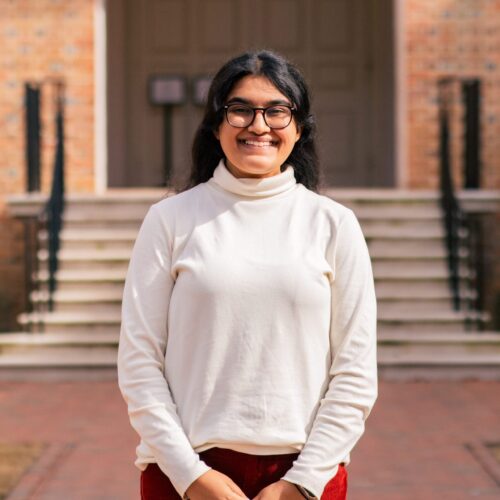
Mona Garimella ’27 (she/her) is a government and psychology double major from Richmond. Mona is the 116th Editor-in-Chief of The Flat Hat. Outside The Flat Hat, she volunteers at The Haven and conducts research on democratic erosion and Afghan resettlement post-2021 evacuations. In her free time, Mona enjoys sudoku, New Yorker articles and coffee shops with friends. You can contact her at mgarimella@wm.edu.
The views expressed in the article are the author’s own.
For the past three years, I’ve spent every other Monday in a windowless room in the Sadler Center basement for around eight hours — seven if we’re lucky — working on pages for The Flat Hat. In that office, I’ve worked alongside three different combinations of a roughly 15-person group. They pull from so many different sides of campus — each person with different majors, interests and reasons for joining the paper — yet we all share some slightly peculiar love for this work. Somehow, spending an entire Monday editing articles, moving around text boxes on Adobe InDesign and arguing over headlines has become one of the most consistent parts of my time at the College of William and Mary.
Oct. 3, The Flat Hat celebrated 115 years since its establishment in 1911. Over that time, thousands of students have done some version of what we do now: document what happens at the College. The people writing those stories have changed, the College they were writing about has changed and the newspaper itself has changed, but those old issues remain a record of what students saw to be important enough to put into print.
The very first article I remember reading in The Flat Hat as a freshman was an opinion piece by then-Editor-in-Chief Molly Parks ’24 titled “A note on student journalism.” In it, Parks wrote, “The Flat Hat is a written and digital record of critical events and topics affecting the College. This paper chronicles the College’s history by students, for students … If you are interested in joining a newspaper staff with the aforementioned qualities, look into The Flat Hat Fall 2023 intern program by emailing our Operations Coordinator.”
So, I joined. At the time, Parks wrote about the more than 70 staff members who made The Flat Hat possible. Today, our staff has grown to more than 100 students, many of whom come from backgrounds that would have prevented them from even attending the College when the newspaper was established in 1911. That history makes the role of The Flat Hat as a record of this institution more complicated than simply celebrating the fact that we have been publishing for 115 years, as who has been able to tell the College’s story has changed alongside who has been able to attend it.
In The Flat Hat’s 50th anniversary issue in 1961, then-Editor-in-Chief Jerry Van Voorhis ’62 wrote that the staff wanted to create a document that represented “fairly” the previous half-century and could serve as a “link among the years.” Sixty-five years later, that phrase still describes one of the most important things this newspaper can do. Students looking backward can see what their predecessors cared about, what students celebrated and criticized, and how this community understood itself at any particular moment.
That record is not always flattering, including to The Flat Hat itself. I would be remiss not to mention that the newspaper has made grave mistakes throughout its own history. Its pages have reflected racism within both the College and the paper, and there have been communities and stories that did not receive the attention they deserved. I don’t think we can meaningfully celebrate 115 years of The Flat Hat without recognizing that our archive documents our own failures alongside our accomplishments. Nor do I think the newspaper we produce today is perfect. There may be decisions we make now that future editors will look back on and question.
What I can say confidently is that the students I work alongside care enormously about getting things right. The Flat Hat does not have professional reporters stationed around campus. It has full-time students going to class, working jobs, writing papers, participating in organizations and then finding the time to attend a Board of Visitors meeting or conduct another interview or stay in the office late to organize stories on InDesign. That does not excuse our mistakes, but I think it explains something important about why student journalism has endured here for 115 years.
There is also something particularly valuable about students reporting on other students. We understand this institution from the inside. We know the conversations happening in classrooms, residence halls and dining halls that may never reach an administrator or professional news organization. That proximity can complicate our reporting at times, but it can also create a level of trust and understanding that is difficult to replicate.
Recent reporting by The Cornell Daily Sun, Cornell University’s student newspaper, is one example of what that relationship can make possible. Senior editor Cereese Qusba followed the case of a student identified as Jane Doe who alleged that seven of her peers gang raped her. Qusba continued following the case — even making calls during her study abroad program in Australia — and developed a relationship with Doe despite broader attention fading after the initial report, ultimately giving a fellow student space to tell a story that might otherwise have disappeared. Her reporting reflects a responsibility I think many student journalists feel: When something happens within our communities, we cannot assume someone else will document it.
That ethical responsibility is particularly resonant at the College because there is still no journalism major here. My colleagues and I have been fortunate to take journalism courses offered through the Charles Center and learn from professionals who practice this work as their livelihood, but much of what I know about journalism has come from experience. The Flat Hat has been its own kind of classroom. I have learned how to ask uncomfortable questions, how to edit another person’s work without erasing their voice and how much a single word can change the meaning of a sentence. More than anything, I have learned that caring about an institution does not mean avoiding criticism of it.
There is a James Baldwin quote I return to often, one that I learned through my high school paper and wrote my college essay about before I ever came to Williamsburg: “I love America more than any other country in the world, and, exactly for this reason, I insist on the right to criticize her perpetually.”
Over the past three years, the College has become my home, and I love this place more than I could have imagined when I arrived as a freshman. It is for that reason, rather than in spite of it, that I see The Flat Hat as such an important conduit for holding this institution accountable. Journalism gives us a way to celebrate this community without pretending it is perfect and to criticize it without giving up on it. When the College succeeds, we document that. When students believe it has failed them, we document that, too.
That is also why the idea of The Flat Hat as a “link among the years” has stuck with me. Eventually, the stories we are publishing now will become the archive. Students who have not yet been born may use our reporting to understand what the College was like in 2026, just as we can open an issue from 1961 or 1911 and try to understand the College those students knew. I hope they find that we documented this place fairly. I also hope they are willing to recognize if we did not.
Most of the time, though, the historical significance of the newspaper is easy to forget when you are working past midnight trying to finish a page. In those moments, The Flat Hat is less an abstract 115-year-old institution than it is the people sitting around me: students who are tired, probably hungry and still arguing over headlines or page colors.
That is what has made this newspaper so personally important to me. It has been life-affirming to work alongside people who care so deeply about telling the stories of this community, even when doing so requires giving up eight hours of a Monday to a windowless basement (Dear Reader, it has become my favorite place). I am grateful for the generations of students who kept The Flat Hat going long enough for me to find it when I arrived here, and even more grateful for the people with whom I now get to carry it forward.
One hundred and fifteen years later, we are still documenting the College by students, for students. I hope that when future generations look back at what we leave behind, they understand their College a little better because we tried.