

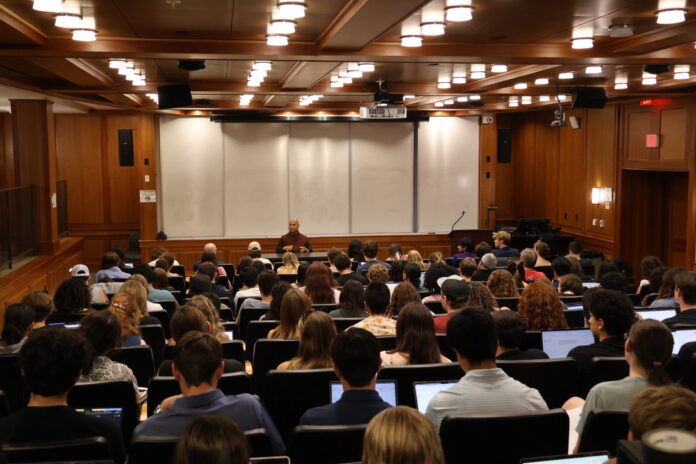
Thursday, Oct. 1, Thích Chúc Thanh, a Vietnamese Buddhist monk, spoke on Buddhist monastic life and meditation at the College of William and Mary. Chúc Thanh is the head of the Dong Hung Temple, known as the Buddhist Education Center of America, in Virginia Beach, Va.
Chúc Thanh greeted audience members in Tucker Hall by instructing them to use their index fingers to push up their cheeks, forming a smile.
“In order to practice the higher yana [enlightenment], you need to practice the push-up right here, so that you can relax yourself,” Chúc Thanh said.
Chúc Thanh said Buddha is not revered as a god but respected as an instructor in Buddhist teachings.
“Buddha never asks you to become his servant, he asks you to become your own Buddha,” he said. “That’s the beauty of the Buddha’s teaching. He never asks his students to just admire him and bow at him.”
Chúc Thanh further distinguished Buddha from a god.
“All of his teaching is like the finger pointing to the target exit over there,” he said.
He emphasized the importance of knowing the Dharma and Buddha’s teachings in addition to making conscious efforts to apply those teachings.
“Right now with super intelligence or AI, you can search what the Buddha taught really easily, just a click, and you know [it] all,” he said. “But how you apply [them] and how you bring [them] into your daily life is a process, and taking time to do that and learning the Dharma is the first step.”
Chúc Thanh emphasized the teaching of contentment.
“The four requisites [are] clothing, walking, food and medicine,” he said. “That’s what we need, and what we want is a lot. You can see that every day we want a lot, but you need just a little in order to live this life.”
He said these materialistic thoughts become easier to abandon once individuals acknowledge them.
“You [can] just recognize them, because Buddha says that our minds have [a] beautiful, very strong capacity to let go if we recognize the problem,” Chúc Thanh said.
Chúc Thanh explained how Śāriputra, the chief disciple of the Buddha, extended the idea of contentment to accepting others as they are.
“[Śāriputra] practiced like the earth,” Chúc Thanh said. “[The] earth never complains. People spit on the earth, and the earth never feels excited when people put flowers on [it]. Earth embraces them all.”
Chúc Thanh also provided easy ways to practice Buddhism. The first was by wishing others in the world well.
“You can practice by saying, ‘May all beings in the North, the West, the East, the South live in peace, free from anger, free from jealousy. May they live with a good cause and good result,’” he said. “You will see that you receive the amplified back.”
Speaking kindness into the world gives someone good karma and decreases conflict, he added.
Chúc Thanh said his nickname, the “Smiling Monk,” relates to his devotion to laughter.
“I practice the ‘Hahayana,’” he said. “That’s why I make you laugh, enjoy life. Life is so short. And who knows? See, you are here today. I’m here today. Maybe I’m not here tomorrow.”
Reflecting on the talk, Danny McGlynn ’30 focused on Chúc Thanh’s portrayal of the Buddha as a teacher.
“I found it interesting when he was talking about the Buddha,” McGlynn said. “He wanted people to respect him as a teacher but didn’t want people to worship him or be his servant.”
Emma Staeger ’27 also attended the talk, finding it insightful.
“[Chúc Thanh] was very wise and spoke about meaningful ways to live out your life regardless of your religious or spiritual beliefs.”
