

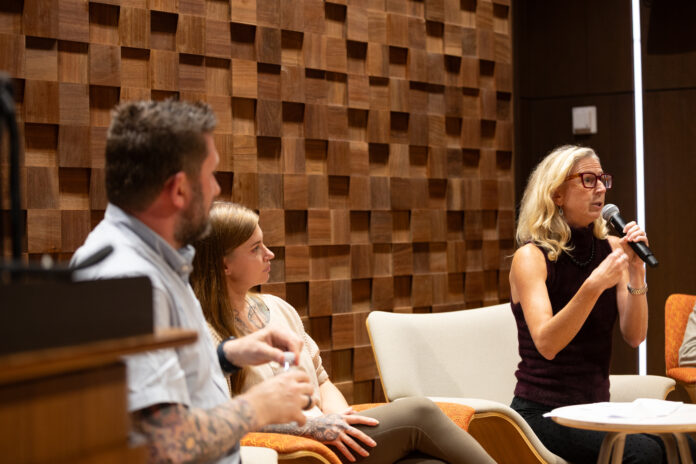
Tuesday, Sept. 22, researchers in the College of William and Mary’s Promises and Pathways team hosted a panel discussion on the lived experiences of Afghans migrating to the United States after evacuating Afghanistan in 2021 due to Taliban takeover.
Nara Sritharan is a research scientist at AidData, faculty affiliate for the College’s Department of Economics and a project lead for Promises and Pathways. She introduced the event and its sponsors.
Zahra Rahimi ’28, a student researcher for Promises and Pathways, then provided background on the event’s topic. She mentioned the 2021 United States’ withdrawal from Afghanistan and how it left the thousands of Afghans who collaborated with the United States against the Taliban in a perilous position.
“When the [United States] withdrew from Afghanistan in August 2021, and the Taliban returned to power, many of these wartime allies were evacuated and eventually resettled in the United States,” Rahimi said. “But many others were left behind or remained somewhere in the immigration and location process.”
Tajalla Moslih ’27, another student research assistant, introduced the panelists: #AfghanEvac founder Shawn VanDiver, NXT Mission CEO Rebekah Edmondson and City Councilwoman and Founder of the College’s Law School’s Immigration Clinic Stacy Kern-Scheerer. VanDiver and Edmondson are both U.S. military veterans.
Bryan Burgess ’18, a senior policy specialist at AidData and a project lead for Promises and Pathways, moderated the discussion.
VanDiver described the federal government’s role in #AfghanEvac’s work in advocating for and helping resettle Afghan allies to the United States.
VanDiver said he believes the U.S. government is no longer interested in helping immigrants or refugees, particularly Afghans.
VanDiver said #AfghanEvac has pushed news stories to raise awareness and continued bipartisan outreach.
Edmondson spoke on her obligation to aid members of the Afghan military’s Female Tactical Platoon.
Edmondson said the current Trump administration has made it difficult for FTP members to obtain green cards, including those who want to join the U.S. military.
Kern-Scheerer then explained how her involvement with Afghans started at Fort Lee, a U.S. Army training installation located in central Virginia.
“It was a place where families were first sent, in this area, and they put out a call for lawyers to come to Fort Lee and help fill out green card applications, fill out work permit applications,” she said.
Kern-Scheerer described the struggles Afghans allied to the United States face, such as the two years they must wait before receiving a green card.
Kern-Scheerer mentioned that some Afghans allied with the United States destroyed their documents to avoid retaliation from the Taliban. She also discussed how the termination of Temporary Protected Status for Afghan migrants in the United States further threatened their legal status.
“Everything got much more difficult because the view [around] the safety of Afghan[s], the view of what’s going to happen if you have to return [to Afghanistan], has changed quite dramatically,” Kern-Scheerer said.
VanDiver noted the number of Afghan migrants still stuck in a refugee camp in Qatar and the difference between the treatment of Afghan and white migrants in the United States.
“Five Afghans have arrived in total this year,” he said. “16,000 white South Africans have [also] arrived, and [the federal government] broke every rule to get these folks here.”
VanDiver advocated for reextending Temporary Protected Status for Afghan migrants, particularly those who allied with the United States against the Taliban.
“Every single person who stood up for the idea of democracy, and is now in danger, should be here [and] have their shot at the American dream,” he said.
Edmondson said she believed protecting Afghans allied to the United States is an important way to honor American service members.
A question-and-answer session and reception followed the initial panel discussion.
Jarett Stephens ’28, treasurer for the College’s Fighting for Immigrant Rights and Equity chapter, said they were aware of Edmondson’s advocacy.
“I thought that this would be a good opportunity to explore how the [immigration] process has changed over time and how the lived experiences of Afghan allies have been impacted and devastated because of the new administration,” they said.
Stephens said they hoped to engage in advocacy for Afghan migrants and that they wish to pursue immigration law in the future.
Moslih described what she sees as significant regarding Afghan migrant research.
“Behind every number, there’s a story, there’s a human being,” Moslih said. “Interviewing [Afghan] migrants definitely impacted me emotionally because of how much they have faced and dealt with on their immigration journey pathway. It really inspires me, the courage that they have.”
