

Carson Burch ’27 is a government major from Chesapeake, Virginia. He is a member of the History Club, Public Policy Club, Lutheran Students’ Association and Theodore Roosevelt Society. Outside of his studies and social life, he enjoys reading about historical and current events in addition to dinosaurs.
The views expressed in the article are the author’s own.
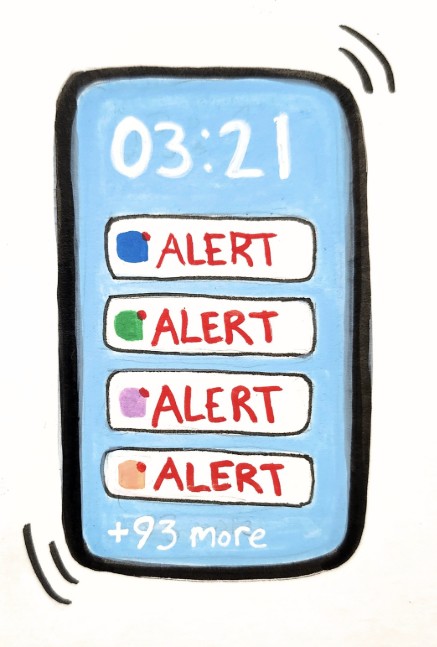
At the risk of sounding like a boomer who whines incessantly about kids these days, one of the defining characteristics of our generation’s lifestyle is that we spend so much time on our phones — we might as well glue them to our hands. Everywhere we go, we carry small computers that give us access to vast amounts of information and allow us to do anything. With just a few taps of a button, we are immediately inundated with (to steal the chorus lyrics from Bo Burnham’s “Welcome to the Internet”) “a little bit of everything, all of the time.”
And it’s all taking away some of the things that matter most in our lives.
I’ve touched on the topic of social isolation before, and I will once again reiterate my theory that spending too much time on our phones is the biggest contributor, as it forestalls interactions with the people in our lives. However, I think the issue is deeper: We’re replacing activities that once defined the human experience with the soullessness of scrolling. The consequences of this have only been negative.
A superb example of this trend is replacing the habit of reading books with scrolling through videos on YouTube or TikTok. Reading and writing were once seen as essential components of civilization but are now increasingly abandoned: Less than half of American adults read any kind of book these days. I am to a moderate extent part of this trend, even as I still read books and love them. I do some of my most prolific reading during my annual summer visit to the town of Warren, Pennsylvania, because internet access is often unreliable in the Allegheny Mountains.
However, that does not mean I prefer social media or that it is better. I actually find passively scrolling through YouTube, looking for the next video, to be less fulfilling than reading a book such as my most recent read, Virgil’s “The Aeneid.” One requires the active engagement of my brain to process words, but the other is merely passive absorption of content. Even movies and TV shows are more rewarding for me, as they require dedicating time, and seeing them with friends (as I often do) adds a social component wholly lacking in anything social media could provide. I highly doubt I am alone in this experience, as I have heard many other people say the same thing.
Another wonderful demonstration of this point would be dating apps. Glancing at a profile and swiping left or right in the hope of finding a date reduces the search for one of the most intimate relationships to an impersonal act — a simple action done with little consideration and no particular special feeling.
Removing the feelings that define lust and love from courtship inherently hollows the process, and honestly, it makes me depressed about the future of one of the most important bonds people can share. It’s not like this digitization has made relationships easier or deeper, given how zoomers are less likely to have had sex or get married than they once were.
What is the solution to this? One of my wonderful editors, Michael Gabriel ’28, has written multiple times about the value of filling otherwise unproductive time with pleasures other than doomscrolling, and he is absolutely right in much of what he says. I would disagree that other alternatives can be “wasting time.” However, reading books can expand one’s knowledge, as reading fiction helps attune one to various cultural references to important works of literature. And attending social events to get to know others helps form connections which could maybe last a lifetime. I’d argue gaming could do the same.
What matters most is that we find activities which nourish us by deepening our connections to the people around us and who actively engage us, rather than simply wasting our time on passive consumption of AI slop. We need to restore the soul to human existence, rather than further its removal, and the only way to do that is to live in the now.
