

Gwendolyn Hughes ’27 is a history major. She is involved in the National Institute of American History & Democracy program for Public History and Material Culture and is passionate about highlighting underrepresented stories and promoting them to larger audiences. Outside of classes, she is in the Spotswood Society, volunteers in Colonial Williamsburg and works as a tour guide at Bacon’s Castle. Contact her at gmhughes01@wm.edu
The views expressed in the article are the author’s own.
Have you ever wondered why we call ourselves the Tribe? Perhaps it’s a suitable name for the College of William and Mary’s students and our strong community. Or maybe you’ve found the name troublesome, as I have, considering the university’s original objective to propagate Christianity among Indigenous populations of the New World. This history alone is enough to question the nickname’s underlying meaning, especially since that context is inscribed on campus in the form of the Brafferton building, which is now the president’s office but was once a school for Native students from across North America. However, when digging through old newspapers and yearbooks for my capstone seminar, I noticed an even more direct connection between the College’s current use of the nickname and the Brafferton Indian School.
Online sources offer only small doses of information about the College’s original mascot, the Indian. This is an unfavorable past that many sports teams share, but I find it crucial to keep digging into why the College adopted it. The school chose the name in the early 1900s, when sports became an identifier and source of pride for American universities. At the time, colleges began adopting descriptive yet “intimidating” characters. A few examples that arose before the College’s Indian include Hampden-Sydney College’s Tigers and the University of Richmond’s Spiders. As more colleges created their own unique identifiers, the College followed suit.
In The Flat Hat’s first publication of the fall 1915 semester, athletic editor William D. Harris proposed implementing the “Indian” as the College’s mascot. In his article, he directly attributes his idea to the colonial era school for Native American boys at the College. Harris’ interest in this subject likely developed because he lived in the Brafferton, which was a dorm at the time. Residents of the building started the Brafferton Indian Club in 1906. They used sheets to dress up and covered their faces in “War Paint” while claiming they were inhabited by the spirit of the “Red Man.” As a member of this club, Harris took this enthusiasm for a “mythical” side of the College’s history and engraved it into the school’s culture.
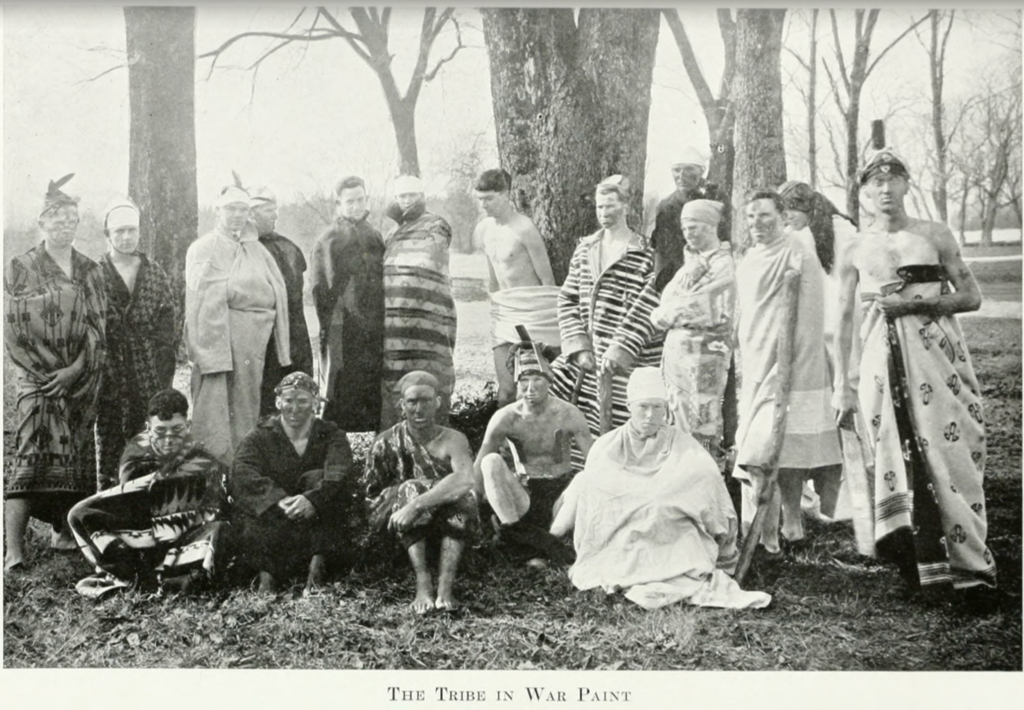
1916 Brafferton Indian Club – Page 149 of the 1916 Colonial Echo
Harris wrote another column in the Richmond Times-Dispatch, spreading word of the new name, and by the 1916 yearbook publication, the athletics pages were introduced by a drawing of the new mascot. By 1917, the baseball team wore uniforms labeled “Indians,” which indicates the official implementation of the name by the athletic teams. Students at the College would embrace the identity of “Indians” for many years to come.
It wasn’t until the early 1980s that the Indian started being phased out by the administration in favor of “Tribe.” This gradually transitioned students to a new, only slightly different identity, avoiding hostile reactions to the change. However, the Indian wasn’t officially eliminated until 2005. Before this, it lived on, occasionally through costume but often through vague imagery and vocabulary. Conversation over the name erupted in 1989. Students debated the nickname’s appropriateness, as many publications continued to use the term “Indian” and football games continued to include traditions such as the tomahawk chop. A few opinion articles in The Flat Hat came close to understanding the relevance of the Brafferton, but many used that to argue why the College should continue embracing its original mascot.
In 2005, University President Gene Nichol chose to maintain the “Tribe” when the NCAA adopted a policy that eliminated mascots disrespectful to Native American culture. Nichol asserted that the school could continue to use the name in the broader sense of the word if they eliminated visual connections, such as the feathers in the College’s logo. In this same statement, he suggested that the nickname “appropriately highlighted the school’s historical connection to the education of Native Americans.” How can these two purposes of the “Tribe” coexist? How can we clearly understand the historical connotation of “Tribe” while also insinuating that the name has nothing to do with Native Americans?
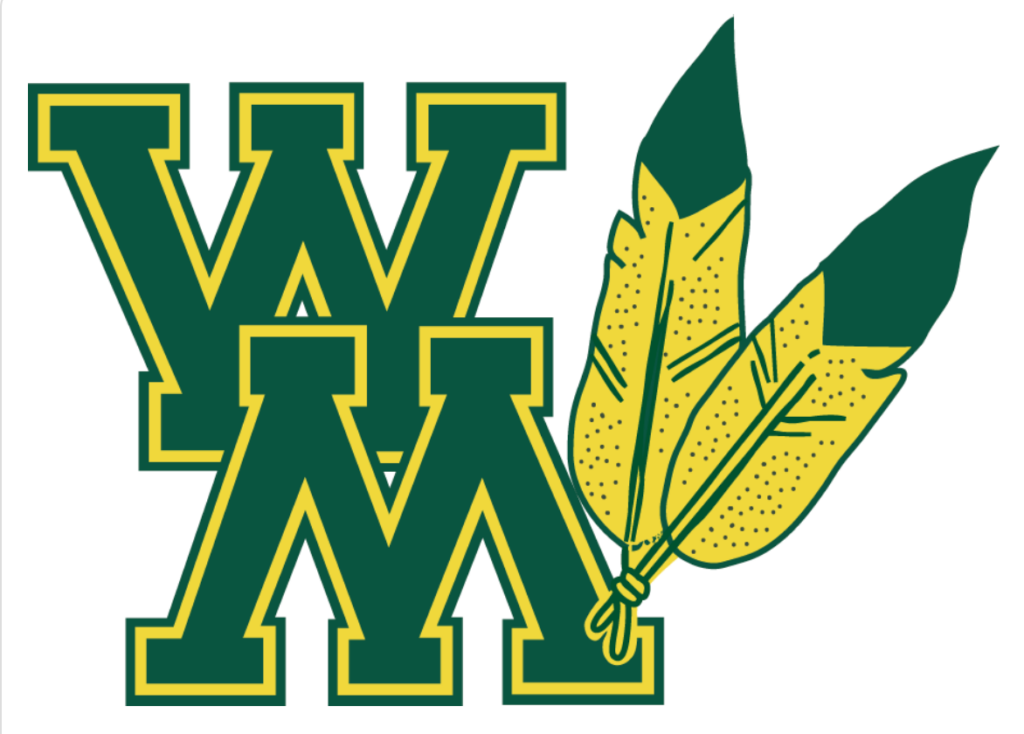
Courtesy Image / Sportslogo
The nickname is in a strange limbo: One could say it promotes the school’s history, but that would mean admitting the nickname connects to Native identity. If you decide it doesn’t highlight the school’s history, you’d have to ignore a lot of historical context. Even outside of the basic context, the direct connection between the Tribe and its origins as a celebration of indoctrination is disturbing. There is no doubt that the word “Tribe” that we use today is a remnant of not just an outdated nickname, but the College’s original pride in Christianizing Native youth.
Does this historical connection mean that our nickname actively disrespects Native culture? That’s not something I, or any other non-Native student at the College, can answer. The College could ultimately support Native communities in ways that would be more beneficial than eliminating the Tribe. What we can do as students is educate ourselves and have meaningful conversations about the words we use to identify our community. I’m not asking you to throw out all your Tribe gear; just consider what it means to you and what it might have meant to students years ago. As a student body, we should try to be independent, critical thinkers, and that means taking a closer look at our shared identity as the Tribe.
