
The College of William and Mary is the kind of place that stops visitors mid step, awestruck, before they can reach the Sunken Garden. Take the Sir Christopher Wren Building, for example. With restored Georgian architecture and a weathered cupola, it could take one back to the days of Thomas Jefferson in an instant. Or maybe the foliage in late October, turning the Crim Dell into a near-Thomas Kinkade painting of reds, oranges and browns. For me, however, I wasn’t truly struck by the College’s beauty until I first entered James Blair Hall.
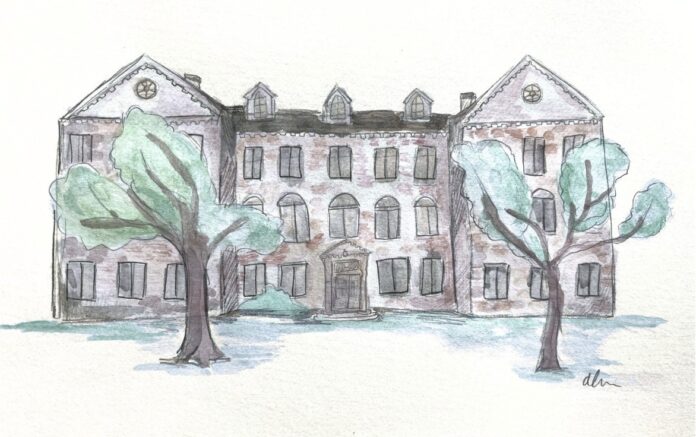
Blair Hall, home to the history and philosophy departments, is a perfect physical manifestation of the “dark academia” aesthetic. From the original walnut wood paneling lining the first floor’s walls to the black-and-white checkered marble floors and gilded light fixtures, the building evokes a sense of historic intrigue that has been lost in other, more recently renovated Old Campus buildings. Walking through Blair’s maze-like corridors of offices feels a bit like stepping into the shoes of the students who walked them almost a century before.
Like most of the buildings surrounding the Sunken Garden, Blair Hall was constructed with funding from a Public Works Administration grant in the mid-1930s during the College’s period of rapid restoration and expansion. Originally called Marshall-Wythe Hall, it housed the economics, government, history and sociology departments as well as the College’s administrative offices and the School of Jurisprudence — later known as the Law School.
Beyond its striking interior, part of what makes Blair Hall most significant is its status as the academic home of the College’s first Black graduate, law school student Edward Augustus Travis B.C.L. ’54. According to “‘The Inevitable Present’: Integration at William & Mary,” a 2013 exhibit at Earl Gregg Swem Library, the College began admitting small numbers of Black students to select professional and graduate programs in 1950. This was in response to a federal court ruling that prevented public institutions from denying students admission into geographically limited programs purely because of their race.
It’s important to note, however, that this decision to integrate was not a choice the College made all that willingly. In fact, an editorial in the October 1950 edition of the Alumni Gazette — the previous name for the alumni magazine — explicitly stated that “the University fought and lost” the integration ruling before admitting its first African American students.
The weight of these students’ combined legacies only grows when you realize that Blair’s appearance has remained almost entirely unchanged since 1950, save for a 1996 renovation to upgrade heating, cooling, lighting and other technology systems. To walk through Blair Hall today is to walk through the same doorways, past the same walls and into the same classrooms that some of the College’s first students of color once did as they carried a weight and courage most of us have never had to know. Despite this, there is no plaque or marker outside Blair’s doors to commemorate their experience at a school that hardly wanted them there.
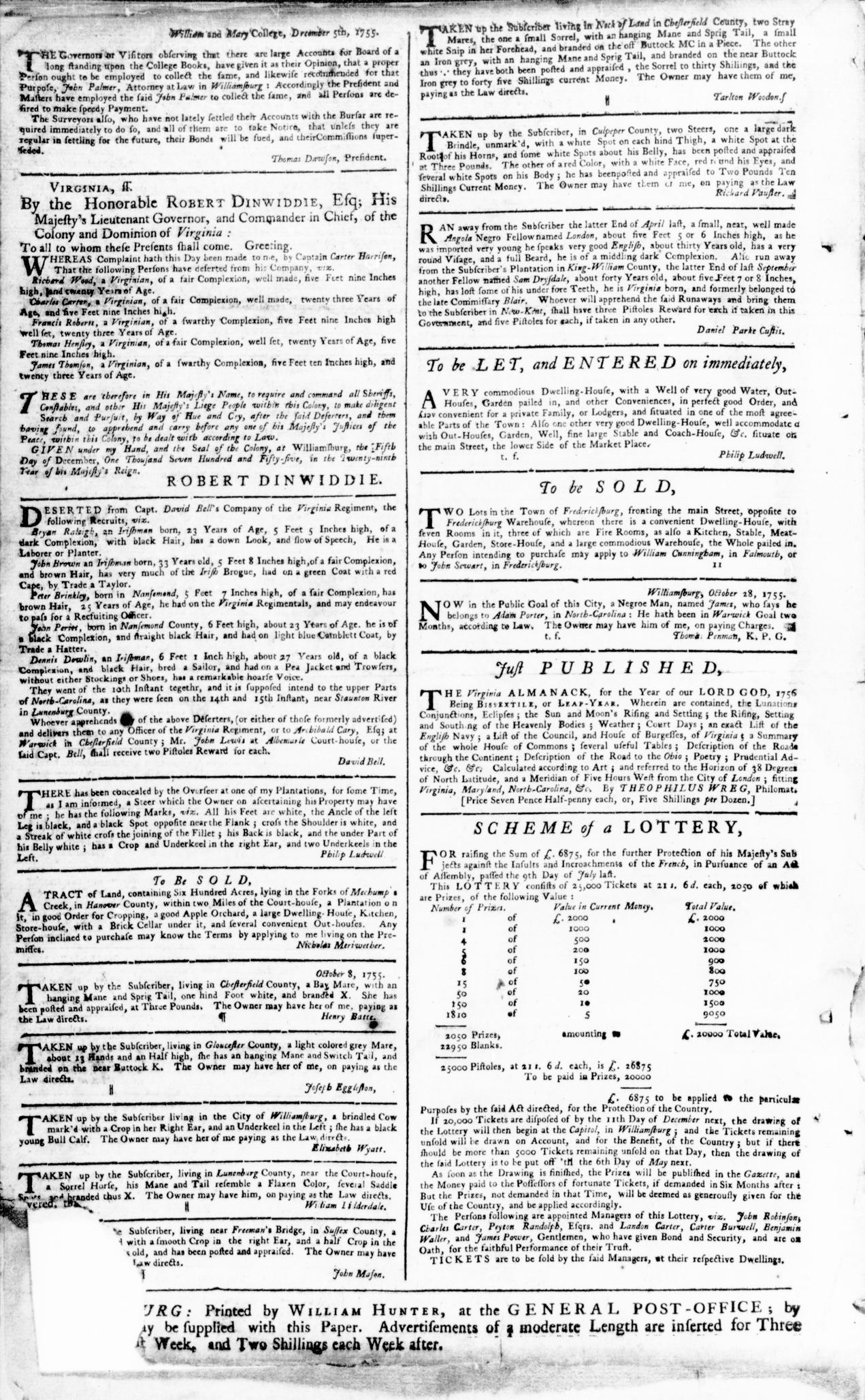
What is present outside of Blair’s doors is the iconic James Blair statue between it and Chancellors Hall. The statue depicts the building’s current namesake, the founder and first president of the College. His statue, with its majestic, flowing robes and book in hand that signal the status of a clergyman and educator overlooking the institution he founded centuries ago, is an unmissable piece of the Sunken Garden’s surrounding landscape. While Blair’s role in the College’s founding, especially the year in which he did so, is often remembered and recited by students and faculty alike, his reliance on enslaved people to not only build the campus’s three original structures but to maintain its day-to-day operations goes largely overlooked. In fact, according to a 1755 notice in the Virginia Gazette about a group of runaway enslaved people, Blair likely not only utilized slavery but owned slaves as well.
The fact that a building whose history is so inextricably entwined with the paths blazed by students of color on the College’s campus is named after a man who both advocated for and perpetuated the practice of slavery is disappointing to say the least. As someone who has long admired Blair Hall for its architectural and historical significance, I struggle to reconcile its two deeply opposing legacies.
Though the College has made a concerted effort over the last decade to rename any buildings with links to racists, slaveowners or Confederate figures, Blair Hall has been curiously left out of the reckoning. While efforts elsewhere across Williamsburg have been made to remove James Blair’s name, most notably a failed attempt to rename James Blair Middle School, there seems to be no indication that Blair Hall will lose its moniker anytime soon, nor that its neighboring statue will gain even so much as a marker noting its subject’s ties to slavery.
Blair Hall was likely never meant to stay frozen in time, slowly watching the buildings around it get their original flooring swapped out for linoleum and their paneling for plaster. Yet it has, with its doorways and floors preserved just as Travis would have first seen them in 1951. That sense of permanence is part of what makes the building so remarkable and helps make silences especially notable. Its century-old walls bear no recognition of either the students who broke barriers within them or the cruelties of the man the building is named for. While I hope students continue to be impressed by Blair Hall’s original beauty for centuries to come, I also hope they can walk to their next history or philosophy class with a profound awareness of the conflicting legacies it holds as we continue to reckon with our deeply troubling history and look towards a brighter future.