

Thursday, March 26, Williamsburg, Va. residents Dennis Gerard and Mark Sullivan stood on Duke of Gloucester Street in Colonial Williamsburg. They carried signs reading “NO KINGS” with golden crowns crossed out in red.
Gerard expressed concern with what he views as political apathy among students at the College of William and Mary.
“I grew up in the late ’60s and early ’70s, so I don’t understand the college apathy,” he said. “We need more sustained involvement by students. We have a rally every Friday at the courthouse, and it’s all gray hairs.”
Sullivan urged students to speak out against what he views as the abuses of President Donald Trump’s administration.
“We need to get out there and show [Trump supporters] that they can’t break all the rules,” he said.
Sullivan explained that his grandkids and their futures are a primary motivation in his protests against the Trump administration.
“I don’t want them to grow up in a situation where there’s no more democracy,” he said.
Adrian Ryan ’27, president of the College’s Young Democrats, described his interpretation of the No Kings protests.
“I expect this upcoming protest to be similar to past No Kings protests,” he said. “I do not expect many college students to participate, but I hope that a lot of college students do turn out.”
Ryan disagreed with Gerard and Sullivan’s assertion about students being politically apathetic to the Trump administration’s actions. Instead, he argued that the timing of the event likely played a role in some students’ absences.
“I don’t expect a lot of college students to attend just because we are at a busy time in the semester,” Ryan said. “I applaud all those who are able to attend the protests and exercise the First Amendment right to do that.”
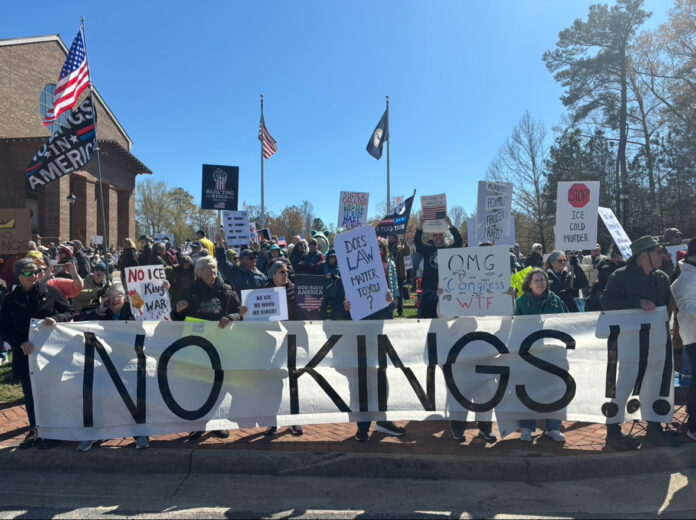
Saturday, March 28, hundreds gathered at the Williamsburg/James City County General District Court for the Williamsburg No Kings protest.
Protesters carried signs and flags against the Trump administration, which referenced the president’s connection to disgraced financier Jeffrey Epstein, the war in Iran, tariffs and recent U.S. Immigration and Customs Enforcement prosecution of immigrant communities.
A College alumnus, who asked to remain anonymous, explained their motivation in attending the protest.
“I think it’s absolutely essential that we get [Trump] out of here,” they said. “This guy’s trouble, and he’s dangerous. He’s acting like a king.”
The alumnus believes that the perceived apathy from students at the College is not new. They said they witnessed similar behavior during the Vietnam War protests.
“I was a student here 50-plus years ago during Vietnam,” the alumnus said. “The students [then] were apathetic. Vietnam was not on most of our radar.”
The alumnus added that they now do some teaching on campus and believes students will become more engaged as they age.
Williamsburg resident Heather Meaney-Allen, one of the speakers at the protest, addressed the importance of the rally’s large turnout.
“We are making history,” Meaney-Allen said. “You made a moral choice coming out here today to have your voice counted.”
Virginia 71st District Delegate Jessica Anderson attended and spoke on why she felt it was important to protest.
“We continue to see unilateral authoritarianism from this president,” Anderson said. “We continue to see him go against our constitution, violate the rights of our citizens and our residents, and now, we’re in a war that we had no congressional approval on.”
Further, attendee and Williamsburg resident Marisol Lambert believes that lower student turnout was driven by a lack of access to transportation.
“I wish we could do it at William and Mary or Colonial Williamsburg,” Lambert said. “I don’t think we should be blaming [students] for these things.”
Sharon Powell, an immigration attorney in the City of Williamsburg, was among the speakers at the rally. Her speech centered on how small acts of political advocacy can create widespread change.
“Hope is what allows people to keep going when systems feel stacked against them,” Powell said. “Hope leads to courage, and courage leads to action, and action leads to change.”
Powell asserted that continued activism for justice requires resilience and determination.
“There are days when the work feels overwhelming,” she said. “Days when the problems feel too big, too entrenched and too urgent, days I look at a sticky note on my computer that asks me one question: ‘What is one small act I can do today to change someone’s life?’ Just one. Not everything. Not solving the whole system. Just one step.”
Powell, who has worked as an immigration attorney for the past 12 years, said that the current level of support and turnout in defense of immigrants has been unprecedentedly high. This inspires her to continue pushing forward in her work.
“We move forward. Not all at once. Not perfectly, but step by step,” Powell said.
