

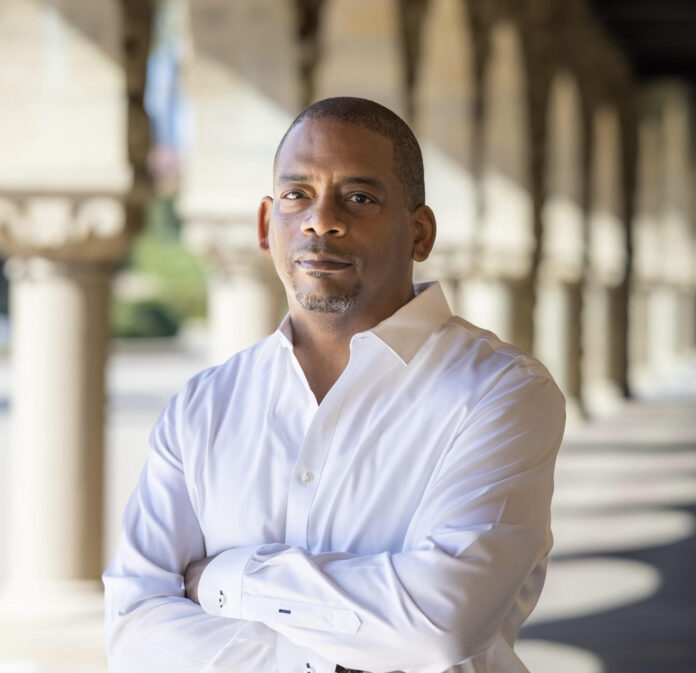
Wednesday, Sept. 9, the College of William and Mary’s English department hosted award-winning poet, writer and Stanford University professor A. Van Jordan as the first speaker of its annual Hayes Writer Series. Jordan is the author of five poetry collections, including “Rise,” “Quantum Lyrics,” “The Cineaste,” “When I Waked, I Cried to Dream Again” and his most famous, “M-A-C-N-O-L-I-A,” which details the life of MacNolia Cox, the first African American top-five finalist in the National Spelling Bee. Jordan is credited with bringing her story back into the mainstream. On Sept. 15, 2021, a Senate resolution celebrated Cox on the 50th anniversary of her death.
Addie Tsai, an associate teaching professor of English who hosted and organized the event, invited Jordan to the College. Tsai recommended Jordan as a speaker because they thought he would connect with their students given the broad range of topics his writing covers, including Black history, literary classics, jazz, film and quantum physics.
Additionally, Tsai liked that Jordan’s writing style was accessible to readers who were new to poetry.
“I think a lot of young writers, especially college students, have been taught that poetry is esoteric and hard to decipher and kind of like this puzzle. And I feel like the language in A. Van Jordan’s poems is really clear and accessible,” they said. “For example, the poems he read about Tamir Rice, I think feel very relatable, resonant, and the lyricism helps counterbalance the intensity of subject matter.”
Earlier in the day, Jordan visited Tsai’s Intro to Fiction class, where he had students analyze two of his poems. He related the exercise to how a director would shoot a film. Aniya Stevens ’29 described Jordan as intelligent, informed and aware.
“He isn’t afraid to talk about deep topics. He isn’t afraid to talk about homophobia, he isn’t afraid to talk about racism and sexism. He isn’t afraid to talk about death,” Stevens said. “And it gives this raw feeling like it isn’t hidden behind words. He just says it, which I definitely appreciate about his writing.”
Stevens, who also interviewed Jordan at the Hayes speaker event in the second half of the event, read Jordan’s poetry to prepare for the interview. Stevens was struck by how well she could relate to his writing and how some of it made her emotional.
“Because I am also Black, you’ll see that we don’t really have a lot of Black poetry in the forefront of media or really acknowledged in society,” she said. “So to see someone who is a Black poet talk about black history, jazz and talk about police brutality — all these topics that we shy away from because we don’t want to talk about it — was very impactful. I think that’s the part that really gets me, because I struggle to sometimes talk about that in my own writing.”
At the Hayes Writer Series event, Jordan provided background on his poems by talking about Tamir Rice, a 12-year-old Black boy killed by police, as well as playing a clip from the film “Do the Right Thing” and sections of music by John Coltrane and Ryan Porter. Jordan then read his poems responding to these pieces of background.
Jordan explained that curiosity was the main reason he incorporated subjects that are not commonly associated with each other. He also hoped to contribute his perspective to different pieces of media he consumed. Jordan cited Spike Lee, Alice Coltrane and Miles Davis as his artistic influences and Robert Hayden and Tim Siebles as writing inspirations.
To Jordan, one of the most important parts of poetry is its continued relevance and power in our current digital age.
“I think poems compete with tweets,” he said. “What happens is that people are in a world in which everything moves at the speed of social media. And then when you get a poem, it doesn’t take long to read a poem, you know, take a minute or two out of your day and read a poem and you take a beat, slow down, and you’re living inside of the turning of someone’s mind as they’re working through an idea. And it’s a privilege to allow yourself that moment. To allow your mind to turn with this other person’s mind.”
Jordan also acknowledged the continuing power a single poem can have, as readers can adopt different interpretations as their lives change.
“There are poems that I’ve read my entire life, and every time I go back to that poem, there’s something new I get out of it depending on what’s happened in my life in between the first time I read the poem and the 100th time I read the poem,” he said. “And so you live a little more and then things start to change as you come back to poems, novels, films, paintings. You just start to have a different relationship with it as you start having a different relationship with yourself.”
Jordan said he is able to connect with audiences who have had limited exposure to poetry because he believes that the human connection and value of poetry has stayed the same. He has done readings at prisons, after-school programs, homeless shelters and senior living centers, many of which have audiences who might not have experienced a poetry reading before. Even so, the readings still had an effect on them.
“I’ve seen them come to tears, I’ve seen them laugh and I’ve had meaningful conversations with people afterward. And it could just be from reading a sonnet, a 14-line poem, and then we could talk for an hour about what came out of that,” he said. “I think it’s still a gift. I don’t care what era we’re in or what other distractions and chatter that might be around younger people, I still think they see the value in poetry when they’re exposed to it.”
Jordan said he was inspired to keep writing and sharing poetry because of events like these, where he could have face-to-face conversations with people, to slow down, to think about what others were talking about, and have the opportunity to have a human-to-human conversation about it.
“What keeps me moving forward is keeping that flame alive and when I am able to share the art with other people, share my poems with other people, and share ideas,” he said.
In his Hayes Writer Series presentation, Jordan highlighted how, when he was first exposed to poetry, he never thought he would become a poet. In school, he originally thought poetry was something he wasn’t good at and didn’t understand. He remembers reading an E. E. Cummings poem and feeling the possibilities of a poem expand for him. He had never read a poem that created a world of ideas, paused and continued on with another idea. Jordan read his poetry over and over again and he felt everything that Cummings said, even if he didn’t necessarily understand everything.
Today, Jordan is working on a collection of poems which will detail the story of Viola Desmond. She was a Canadian beautician who was charged with a violation for refusing to move from her seat in a segregated theater in Nova Scotia in 1946 and was posthumously pardoned in 2010. Today she is on the Canadian ten-dollar bill, and her rebellion has been widely publicized and has contributed to the modern civil rights movement in Canada. Jordan’s poetry collection will focus on movie-going and spectatorship, and the importance of having a connection with others while consuming art.
