

Abby Crespin ’29 is a prospective history major and sociology minor, on a pre-law track (hopefully!), and a member of Delta Gamma sorority. Abby enjoys skiing, thrifting and unnecessarily overthinking.
The views expressed in the article are the author’s own.
In 2020, a new wave of activism emerged, particularly among left-wing youth. I remember feeling caught up in a storm of angry TikTok users who attacked viewers for not signing petitions or marching in Washington, D.C.
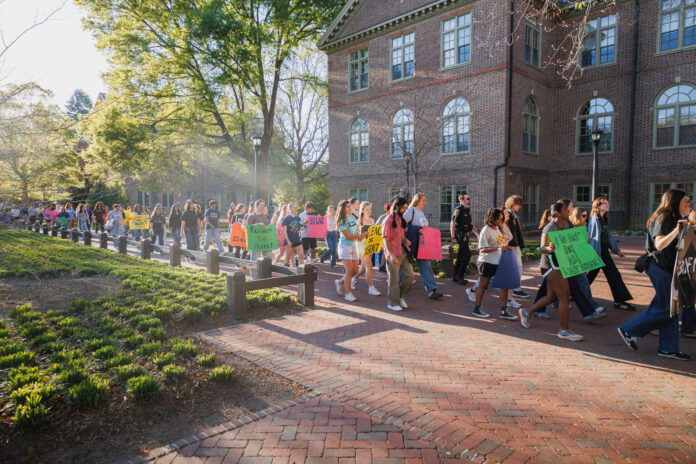
I was always skeptical of this new wave of activism, which I believed wasted energy that should have been directed towards U.S. Congress, rather than the streets in feats of performative activism, prioritizing optics over real change. I was convinced that this new wave of protests was useless, even now, until I recently drove by a group of street-side protesters in my hometown who thoroughly changed my mind.
I could so clearly see the joy in their eyes as their smiles lit up the road. I rolled my windows down to hear their cheers and loud music, and it suddenly occurred to me that these protests were not only not useless, but absolutely necessary.
These community-based protests are not a measure to alert Congress or spark political action; they are about something far more crucial in a world that often feels like it’s on fire. They are about generating hope. In a political climate that demands fear, polarization and burnout, it is crucial that we find ways to generate and preserve this hope.
Over the summer, I participated in a focus group-based ethnographic research study with a Central American immigrant enclave in the DMV. We discussed the heavy emergence of fear within immigrant communities, especially as the Trump administration continues to impose harsh policies and encourage U.S. Immigration and Customs Enforcement raids that disrupt these communities. Participants talked about living in a constant state of anxiety, always monitoring their family members’ Life360 and constantly checking the news. As the study wrapped up, however, we closed by asking how participants maintain a sense of self in such hardship. I watched their eyes light up as they talked about “cantando y bailando,” and I saw even more excitement with the suggestion of organizing community events to sing, dance and cook with one another.
As a teenager with no social media or political platform, I often feel powerless to make a change. I find myself discouraged with the weight of petition signing and scattered elections that I have no confidence my voice will incite any sort of real impact in, but I don’t think any of us are as powerless as we think.
As college students, although it may seem like our voices are limited, we actually have the unique opportunity to connect as a campus, creating meaningful change in a community larger than ourselves. Organizations like Fraternity and Sorority Life, sustainability clubs and student alliances promote unity, which allows students to engage with one another to advocate for collective action.
For a government seeking control, polarization is a weapon. In a democracy, the people are supposed to be the greatest check on government. Democracy is threatened when we are too busy fighting with each other and managing burnout to fulfill that duty. So in a political climate which seeks to unravel democracy, connecting with one another is the greatest protest we can engage in.
This form of protest does not require a grand march into the city with large signs followed by a curated social media post; instead, it depends on building community and practicing self care. With constant media pressure and fearmongering, to prioritize joy is a protest in itself. Whether through roadside gatherings calling for “no kings” or vibrant dinners with friends, producing happiness and finding community are not distractions from resisting democratic erosion — they are acts of resistance themselves.
