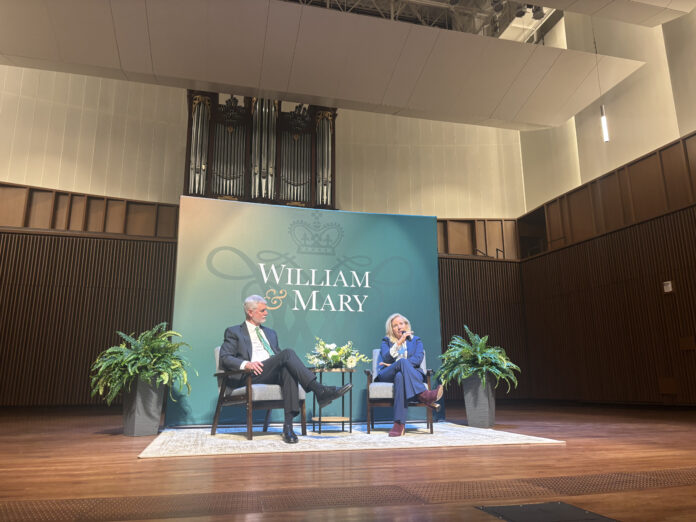
Wednesday, Oct. 14, the College of William and Mary hosted former Congresswoman Liz Cheney for a fireside chat at the Music Arts Center. George and Mary Hylton Professor of International Relations and Director of the College’s Global Research Institute Mike Tierney ’87 moderated the conversation.
Cheney served as the Republican representative for Wyoming’s at-large congressional district from 2017 to 2023. Cheney is known for her work investigating the Jan. 6, 2021 attack on the U.S. Capitol, which alienated her from the Republican Party and led to her loss of the seat.
Cheney’s visit followed her selection as the College’s 2026 Hunter B. Andrews Distinguished Fellow in American Politics. Through the fellowship, the College hosts scholars, journalists and politicians.
College President Katherine A. Rowe opened the event with brief remarks and introduced Cheney and Tierney.
“The Hunter B. Andrews Fellowship has honored William and Mary’s commitment to preparing civic leaders for the past 25 years,” she said. “Each year, we invite distinguished, nationally known leaders and scholars who know a few things about leading positive change.”
In response to a question from Tierney, Cheney said she regretted supporting President Donald Trump before the Jan. 6 attack and that she had expected the White House’s institutional structures to limit his actions.
Cheney said she began questioning Trump’s actions during his first term, particularly after he threatened to withdraw from the North Atlantic Treaty Organization. She described his false claims of voter fraud after the 2020 presidential election as a turning point.
“You can challenge the results if you have evidence that there has been fraud,” she said. “But as the days went by, it became clear that the claims that were being made publicly were not backed by evidence.”
Cheney also cited Trump’s handling of the Jan. 6 attack as a key factor in her decision to withdraw her support.
Tierney asked Cheney why she thought only 10 House Republicans voted to impeach Trump in response to the Jan. 6 attack.
“I was surprised that there weren’t more people who did the right thing in the House,” she said.
Cheney also emphasized the importance of studying the past to move forward, as well as supporting strong leaders. She noted she keeps a photo of former President George H.W. Bush, former National Security Advisor Brent Scowcroft and Dick Cheney, her father, who served as secretary of defense and vice president, in her office.
Cheney said it will likely be challenging for the Republican Party to rebuild its image under its current leadership.
“The Republican Party has lost its way much more than the Democratic Party has,” she added. “The American people deserve a better set of options than the ones that they do now.”
Cheney highlighted the significance of free expression for U.S. institutions of higher learning.
“You’re not at college to have your views reaffirmed. You’re there to learn and to have your views challenged,” she said. “That’s crucially important for our colleges and universities to remember.”
Cheney encouraged students to actively participate in civic life.
“Remember that any important change that has ever been made throughout history only gets made because people stand for it and fight for it,” she said. “Not only can you be involved and make a difference, you have to be, because you just don’t have a choice. There isn’t anybody else.”
Tierney then opened the floor to questions from the audience.
The Flat Hat asked Cheney whether she felt her involvement in the Harris-Walz presidential campaign hurt the Democratic Party’s chances of winning.
“In terms of the 2024 election, I’ll leave it to others to assess the impact,” she said. “Even though [former] Vice President Harris and I had policy disagreements, my decision to support her was borne out of the fact that I understood the threat that Donald Trump posed.”
In response to another audience question, Cheney said she sees the national debt, national security and civic education as some of the country’s biggest future problems.
She said she has reflected on the ways she can build bridges across partisan divides.
“It would be really nice if we could get back to the days when we argued about tax policy,” she added. “Because if we’re arguing about that, it means we aren’t having to worry about democracy itself.”
Cheney did not rule out the possibility of running for national public office again.
“I will not sit here today and tell you that I know that I’m done with political office,” she said. “I don’t know what the future will hold.”
An audience member asked Cheney about her relationship with her father.
“I’m tremendously blessed to be his daughter,” she said. “To have had the opportunity to watch how he served and to have watched in particular the decisions made in the aftermath of 9/11 that in my view kept us safe [and] prevented another mass attack.”
In response to the final audience question, Cheney expressed uncertainty about what may happen at the end of Trump’s term.
“Although we have never been through this before, we have proven time and time again that when we have faced crises, we have come through them,” she said. “Our republic has survived.”