

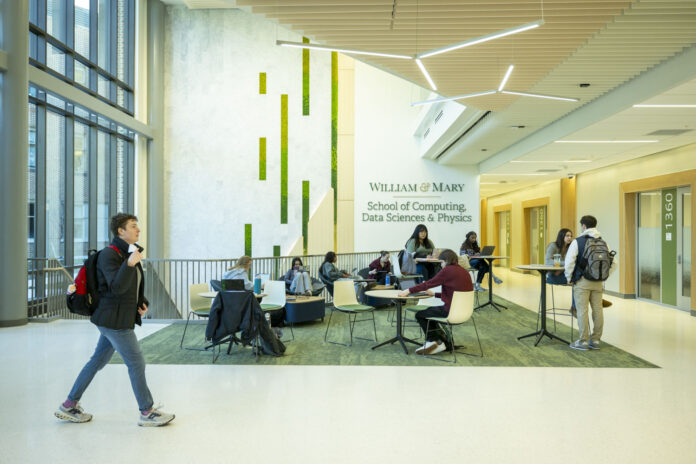
The College of William and Mary’s School of Computing, Data Sciences & Physics will offer a new major in applied artificial intelligence this fall. It will provide students with the skills to utilize AI technology tools in the workplace and their personal lives.
A press release by the College said the major fits into the school’s goal of expanding AI programs.
“[The applied AI major will] provide multiple pathways for students to develop technical knowledge while exploring the ethical, societal and human dimensions of one of the most transformative technologies of our time,” it said.
Adina Allen Term Distinguished Associate Professor of Data Science and Chair of Data Science Dan Runfola said the major was designed to be a second major for students not in AI-related fields.
“We really want to attract students that may not necessarily think that AI is for them and be able to give them a learning experience where they can learn what they could do with these tools,” he said.
Runfola said the new applied AI courses will focus more on the usage of AI tools, rather than the technical skills behind the development of AI programs.
“Imagine the difference between learning how to build a bike and ride a bike,” he said. “Applied AI is how to ride a bike. Data science, computer science, those are about how to build the bike. It’s almost like two different skill sets in that regard.”
Runfola said applied AI courses will require very little preexisting knowledge from students and all necessary programming skills will be taught.
“You’ll learn a tiny bit of math, but just enough to be able to assess the quality of these AI outputs,” he said. “We are not depth-based in either programming or math.”
Runfola said a high proportion of jobs across disciplines require some ability to utilize AI tools. He said he believes the major will be a valuable resource as students look for work after graduation.
“Almost 58% of employers right now are saying they’re assigning individuals tasks that use AI and AI skills,” he said. “We want William and Mary students to come out with a commanding knowledge of how to use these things.”
CDSP Director of Communications and Marketing Randy Ready explained the College’s three levels of AI proficiency: literacy, fluency and mastery. He said students could gain AI literacy by taking basic courses on AI usage.
“AI literacy — that’s where you’re looking at taking individual courses like the AI music course, or we have some different minors,” he said.
Ready said the goal of the major is to get students involved in the next level of AI proficiency: fluency.
“The AI fluency is more [what] this applied AI degree [offers],” he said. “So it’s a higher level than what those minors would offer, but it’s also less than the AI mastery, which is really technical.”
Runfola said the major is built around three key courses: Reasoning with Generative AI, Designing AI Agents and Agentic Coordination.
Beyond this core coursework, Runfola said he hopes to develop courses that will target students’ specific fields and teach department-specific AI integration methods. Runfola provided examples of new and soon-to-launch AI-integrated courses in the music and government departments. He said these courses would be taught by professors in those departments, not by data science professors.
“We want students to understand how AI is used in their discipline as much as we want them to understand the general underpinnings of how these tools can be used,” he said.
Runfola said he hopes his department will allow more students to engage with events and programs in the CDSP field. One of these is the joint colloquium between data science and computer science.
“Last year, we had some really impressive talks on AI applications to satellite and remote sensing, earthquakes, water and water security — how you could use AI in those contexts,” he said. “A lot of very applied topics.”
Runfola also mentioned the student-led AI Club, which launched in spring 2025, as well as a hackathon, as ways to engage students in the school’s new AI-focused programs.
“And many of the students that were involved [in those opportunities] were not programmers,” he said. “They were interested in environmental science and other types of topics.”
Runfola believes new generative AI tools will make AI applications more accessible to students than ever before.
“Generative AI has opened up the door to being able to use these tools to a much, much wider range of students,” he said. “We want to start encouraging students, therefore, to get more involved with us on the research front.”
